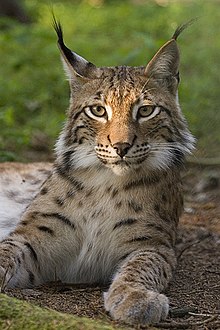
So here's the info on lynxes... Thank you, Wikipedia!
Lynx have a short tail, characteristic tufts of black hair on the tips of their ears, large, padded paws for walking on snow and long whiskers on the face. Under their neck, they have a ruff which has black bars resembling a bow tie although this is often not visible.
Body colour varies from medium brown to goldish to beige-white, and is occasionally marked with dark brown spots, especially on the limbs. All species of lynx have white fur on their chests, bellies and on the insides of their legs, fur which is an extension of the chest and belly fur. The lynx's colouring, fur length and paw size vary according to the climate in their range. In the Southwestern United States, they are short-haired, dark in colour and their paws are smaller and less padded. As climates get colder and more northerly, lynx have progressively thicker fur, lighter colour, and their paws are larger and more padded to adapt to the snow. Their paws may be larger than a human hand or foot.
The smallest species are the bobcat and the Canada lynx, while the largest is the Eurasian lynx, with considerable variations within species.
| Species | Weight | Length | Height (standing at shoulders) | |
|---|---|---|---|---|
| Eurasian lynx | males | 18 to 30 kilograms (40 to 66 lb) | 81 to 129 centimetres (32 to 51 in) | 70 centimetres (28 in)[5] |
| females | 18 kilograms (40 lb) | |||
| Canada lynx | 8 to 11 kilograms (18 to 24 lb) | 80 to 105 centimetres (31 to 41 in) | 48 to 56 centimetres (19 to 22 in)[6] | |
| Iberian lynx | males | 12.9 kilograms (28 lb) | 85 to 110 centimetres (33 to 43 in) | 60 to 70 centimetres (24 to 28 in)[7][8][9] |
| females | 9.4 kilograms (21 lb) | |||
| Bobcat | males | 7.3 to 14 kilograms (16 to 31 lb)[10] | 71 to 100 centimetres (28 to 39 in)[10] | 51 to 61 centimetres (20 to 24 in)[11] |
| females | 9.1 kilograms (20 lb) |
Species
The four living species of the Lynx genus are believed to have evolved from the "Issoire lynx", which lived in Europe and Africa during the late Pliocene to early Pleistocene. The Pliocene felid Felis rexroadensisfrom North America has been proposed as an even earlier ancestor; however, this was larger than any living species, and is not currently classified as a true lynx.[12]

