Sunday, April 28, 2024

"O Happy Day" - the origins

 How did we get from this staid English hymn writer

Philip Doddridge (1702-1751)
Hymn writer & Congregationalist minister

to "O Happy Day" by the Edwin Hawkins Singers,

 international hit in 1969?

Listen, my children, and you shall hear.

Philip Doddridge (1702-1751), an English

Nonconformist minister and hymnwriter, 

composed a hymn

titled "O happy day that fixed my choice" 

based on Acts 8:26-40, in which a court official of Candace, queen of the Ethiopians, 

hears the good news of Jesus from the apostle Philip.

The South African Youth Choir in 2010

In 1755 Doddridge's words were set to a 1704 melody by J.A. Freylinghausen, a German priest and director of orphanages, who wrote 44 hymns and published hymn books.  His most popular collection, known as Freylinghausen's Songbook, included "O happy day that fixed my choice."

A century and a half later, an English organist of French Huguenot descent Edward F. Rimbault, wrote a new melody for the song and added a chorus. His version published in 1854 became popular, especially at baptisms and confirmations.

In 1967 the gospel musician Edwin Hawkins recorded a new gospel-style arrangement of "Oh Happy Day," which with lead singer Dorothy Morrison became an international hit in 1969.

And that, my children, is how an English hymn from 1755 came to be introduced as "an American traditional song" when sung by 27,000 people in Riga, Latvia, in 2014 at the World Choir Games, the world's largest choir competition.


the

Friday, July 24, 2020

Amazing Comet NEOWISE

NEOWISE Comet - Photo by Tim Eggebroten, Seattle WA July 2020

Here is Comet NEOWISE moving through the northwest sky above Seattle, taken by my nephew Tim Eggebroten using a DSLR, 200 mm lens, with a tripod at Golden Gardens Park.

Even from the light-polluted sky of Los Angeles, I was able to spot the comet using binoculars on July 17 in the northwest sky beneath the Big Dipper (aka Ursa Major).  It formed a triangle with the two stars of the bear's front foot... and the next night it had moved on.

3-D Animation by Phoenix7777
What a humbling experience to see debris from the formation of our solar system.  It was the most ancient rock I have ever seen.

I stood before it in awe saying "Hi!  I'm witnessing you as you move past my planet.  In my very short life, what a wonder to witness you, who have been circling the sun for 4.6 billion years!"

This ice from the deep deep freeze of our outer solar system is like a moth circling a flame.  As the comet nears the sun, hydrogen fire melts and burns some of its icy gas and dirt, producing the brilliant tail (well, two streams for a while--the dust tail and the ion tail).


To the right is an animation of NEOWISE moving from beneath the plane of the solar system, up through the plane as it passes the sun and then moving away to exit the inner solar system for another 6,800 years. 


NASA says at Space.com:
We now know that comets are leftovers from the dawn of our solar system around 4.6 billion years ago, and consist mostly of ice coated with dark organic material. They have been referred to as "dirty snowballs." They may yield important clues about the formation of our solar system.

Comets orbit the sun, but most are believed to inhabit in an area known as the Oort Cloud, far beyond the orbit of Pluto. 

This animation and more information and photos can be found on Wikipedia

The 3-D animation is by Phoenix7777 - Own work Data source: HORIZONS System, JPL, NASA, CC BY-SA 4.0, https://commons.wikimedia.org/w/index.php?curid=92399243.


Thursday, June 18, 2020

If a cat needs love...

Clio wants to be outside with us if we're all outside.

If a cat needs love, why shouldn't the Creator need love?

So many animals have evolved to need each other for survival.

Some travel in herds or schools, some just by twos and threes.

If there is a mind behind the Universe or Multiverse...

It seems reasonable that the Knowing beyond all knowing

Needs to be known, though need is indeed a strange verb

To follow the Great Noun, the Name, HaShem.

If God is

And if God is love, perhaps it's true that God needs love, 

Needs us. 


“I think it pisses God off if you walk by the color purple in a field somewhere and don't notice it. People think pleasing God is all God cares about. But any fool living in the world can see it always trying to please us back.”
― Alice Walker, The Color Purple

Wednesday, January 1, 2020

Rocks echo joy

Summit Lake, Yukon Territory, Canada, between Skagway AK and Fraser, Yukon, September 13, 2019

"While fields and floods, rocks, hills, and plains repeat the sounding joy." 

 
Rocks do a great job of echoing..


💙💙💙💙💙💙.

Sunday, September 22, 2019

"...Nor thorns infest the ground"

Church yard of St. Mary's Episcopal Church, Anchorage, Alaska

"No more let sins and sorrows grow, nor thorns infest the ground."    

         --- Joy to the World


Doing my best to pull out invasive non-native thistles and leave only plants that are native.

👌


Monday, April 30, 2018

Earth is Heavenly


Dog sledding above the Arctic Circle in Norway. Jim Lovell says it’s not that you go to heaven when you die, but “you go to heaven when you’re born.” Earth is the best planet in our solar system. We go to space to save the Earth.
0:22
391K views

I love this tweet by Jeff Bezos on Earth Day 2018 !

It’s not that you go to heaven when you die, but “you go to heaven when you’re born.”

Bezos is quoting US astronaut Jim Lovell.

Sunday, March 25, 2018

Blessy

Today I hereby coin a new word: blessy.

A friend emailed me describing the last six months of her life as "the whole blessed/messy process."


Difficult tasks got done, slowly, or fairly quickly, depending on one's point of view.  Godspeed.


The sadness of letting go of two family members was balanced by the contentment of having cared for them as well as possible in their last years.


It was a blessed time; it was a difficult and messy time.


Blessy.  


Thank you to a different friend, Barbra Graber for finding and sending me this photo.


Saturday, March 24, 2018

Poppies! Persistent...


The humblest and happiest flower on earth is the California poppy.

It can grow in the driest dirt, in the smallest crack.  All is needs is one good rainstorm and it's sprouting.  

We've had a very dry winter in 2017-2018.  The abundance of last year is not happening... "but still she persisted."

Monday, January 1, 2018

The Southern Cross


This photo of the Southern Cross is from Science-Photo-Library, which I accessed through Cafe Press.

We can't see this constellation in the northern hemisphere, but I saw it ten years ago in Argentina.

Here in the north, on New Year's Eve, I love to look out at Orion at midnight and remember where Earth is in its rotation around the Sun.

Wish I were in Colorado or the high desert of California! It's barely possible to see Orion most winter nights in Los Angeles.

I printed this photo for my Christmas cards this year, thanks to Cafe Press.

Thursday, December 28, 2017

Wild Turkeys at Christmas


And now turkeys...

It turns out turkeys live in the wilderness area around Trout Lake near Telluride, Colorado.

My neighbor sees them eating grass near her house on these cold but snowless winter days.

She took this photo near the house further on down the hill between her house and mine.

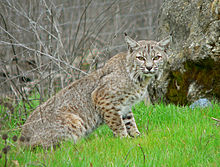
Introducing the bobcat...


Below is a link to a l-o-o-o-n-g jump by a bobcat... sorry I can't actually put it on this blog.

https://www.facebook.com/NSelection/videos/10154299607351244/?hc_ref=ARRF1hqVXTjKDDGFdcDOC2Zkov7tGqjmVwPjJ9LBRUeYHHXG2zRi4SiKiYPYFsmms-8&pnref=story

Thanks to my high school classmate Linda Binns Monteith for this video from BBC Planet Earth.

Plenty of time to observe the cat and compare it to the earlier photo of the lynx in our driveway.

Here's what Wikipedia has to say about bobcats:  https://en.wikipedia.org/wiki/Bobcat

And here's the intro:
The bobcat (Lynx rufus) is a North American cat that appeared during the Irvingtonian stage of around 1.8 million years ago (AEO).[2] Containing 12 recognized subspecies, it ranges from southern Canada to central Mexico, including most of the contiguous United States. The bobcat is an adaptable predator that inhabits wooded areas, as well as semidesert, urban edge, forest edge, and swampland environments. It remains in some of its original range, but populations are vulnerable to local extinction ("extirpation") by coyotes and domestic animals. With a gray to brown coat, whiskered face, and black-tufted ears, the bobcat resembles the other species of the midsized Lynx genus. It is smaller on average than the Canada lynx, with which it shares parts of its range, but is about twice as large as the domestic cat. It has distinctive black bars on its forelegs and a black-tipped, stubby tail, from which it derives its name.
Though the bobcat prefers rabbits and hares, it hunts insectschickensgeese and other birds, small rodents, and deer. Prey selection depends on location and habitat, season, and abundance. Like most cats, the bobcat is territorial and largely solitary, although with some overlap in home ranges. It uses several methods to mark its territorial boundaries, including claw marks and deposits of urine or feces. The bobcat breeds from winter into spring and has a gestation period of about two months.

Wednesday, December 20, 2017

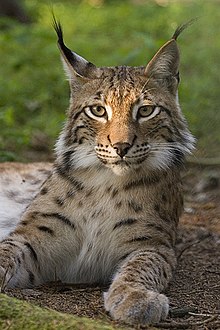
Identifying the lynx...


So here's the info on lynxes...  Thank you, Wikipedia!

Lynx have a short tail, characteristic tufts of black hair on the tips of their ears, large, padded paws for walking on snow and long whiskers on the face. Under their neck, they have a ruff which has black bars resembling a bow tie although this is often not visible.
Body colour varies from medium brown to goldish to beige-white, and is occasionally marked with dark brown spots, especially on the limbs. All species of lynx have white fur on their chests, bellies and on the insides of their legs, fur which is an extension of the chest and belly fur. The lynx's colouring, fur length and paw size vary according to the climate in their range. In the Southwestern United States, they are short-haired, dark in colour and their paws are smaller and less padded. As climates get colder and more northerly, lynx have progressively thicker fur, lighter colour, and their paws are larger and more padded to adapt to the snow. Their paws may be larger than a human hand or foot.
The smallest species are the bobcat and the Canada lynx, while the largest is the Eurasian lynx, with considerable variations within species.
Physical characteristics of Lynx species
SpeciesWeightLengthHeight (standing at shoulders)
Eurasian lynxmales18 to 30 kilograms (40 to 66 lb)81 to 129 centimetres (32 to 51 in)70 centimetres (28 in)[5]
females18 kilograms (40 lb)
Canada lynx8 to 11 kilograms (18 to 24 lb)80 to 105 centimetres (31 to 41 in)48 to 56 centimetres (19 to 22 in)[6]
Iberian lynxmales12.9 kilograms (28 lb)85 to 110 centimetres (33 to 43 in)60 to 70 centimetres (24 to 28 in)[7][8][9]
females9.4 kilograms (21 lb)
Bobcatmales7.3 to 14 kilograms (16 to 31 lb)[10]71 to 100 centimetres (28 to 39 in)[10]51 to 61 centimetres (20 to 24 in)[11]
females9.1 kilograms (20 lb)

Species

The four living species of the Lynx genus are believed to have evolved from the "Issoire lynx", which lived in Europe and Africa during the late Pliocene to early Pleistocene. The Pliocene felid Felis rexroadensisfrom North America has been proposed as an even earlier ancestor; however, this was larger than any living species, and is not currently classified as a true lynx.[12]

Saturday, December 9, 2017

A well-fed cat...

Here, kitty, kitty...

Is this visitor a bobcat or a lynx?  It's walking down the driveway of my house at Trout Lake as if it owns the place... which I guess it does, 90% of the year.

I contacted Telluride native Jack Pera, who has done lots of nature photography around San Miguel County, with this question.

Here's his answer:

The photo of the 'cat is indeed that of a lynx. I can tell by the color. There are other identification marks but the photo isn't good enough to point those out. (Extremely large feet, black tip on the tail, longer ear tufts, etc.) The main food source is snowshoe rabbits (hares.) Their survival depends almost entirely on the population of this species of rabbit. Deb sees lynx tracks on occasion when she snowshoes above the cabin but hasn't seen one yet and neither have I. It's a treat to get to see one.

Donna Nichols reports:

I didn't see it but my nephews did. Tom showed them pix of both.  They said lynx. !  I've seen lynx in that area before a few years back closer to Rico though. [Over Thanksgiving] I saw its tracks in the snow go under the porch of a cabin for sale.  I saw little tracks too...cub?

My neighbor Heather noted:

I actually have only ever seen a cat in our driveway once. I think it was a lynx. But it was like this, broad daylight, and I was out walking [my dog] Maggie. She had a fit and it sauntered off down toward Sue's.

From now on, I'm keeping a log of sightings!  

A few moose have shown up in the last few years, hiking over from Ophir.  Deer, weasels, rabbits, and porcupines are frequent visitors.

Note: Jack is my second cousin.  He used to produce a slideshow of his photos called Mountain Splendor.

This I Believe

I sat in the School of Christian Learning—sort of an adult Sunday school—listening to Dr. Jeffrey Siker speak.  He’d been imported from Loyola Marymount University to present four lectures about Bible interpretation on Sunday mornings before worship at 10:30. Because he’s a New Testament scholar and faithful Christian with a sense of humor, I respect him a lot.
            But then he said, “I don’t believe in the Virgin birth.”  That got my attention.  I knew that the birth narratives—shepherds, wise men, etc.—appear in only two of the Gospels, and that all four accounts of Jesus’s life were written forty to sixty years after his death.
            Jeff was saying, however, that most scholars believe that the “baby in a manger” story was added as legends grew after the death and resurrection.  The savior of the world needed an impressive birth to match the end of the story. 
            It made sense, and I felt my eyes swell with tears as I sat in my folding chair taking notes.  I love the angel coming to Mary, the humble birth, the shepherds, and the Magi from the East.  Surely the Creator of the universe, who chose to enter a human body to reach out to creatures “in God’s image” on planet Earth, could have pulled off a few miracles at birth as well as at the end of Jesus’s life.  But did they actually happen?  I could feel my years of belief in these gospel truths slipping away, and the loss hurt.
            Of course the date of December 25 was completely arbitrary, a product of Christianity’s marriage to the Roman Empire, but I prided myself on keeping the Christ in Christmas.  I never told my kids there was a Santa Claus; instead we read accounts of the 3rd- 4th century St. Nicholas.  I allowed them a pagan Christmas tree, but we also set up a creche scene of wooden pieces representing the shepherds and sheep, cow, donkey with Mary and Joseph, camels, Magi, and angels, all surrounded by votive candles.  The cow had to stand by the manger, awaiting the rest of them, while the baby Jesus was hidden until Christmas Eve. 
            Was all that just a lovely legend, like jolly St. Nick and the reindeer?  I pondered it in my heart for seven or eight years. 
            In December, 2017, Los Angeles County was attacked by unseasonal fires and as Advent began, smoke crossed the skies day and night.  A few days later, however, I noticed two rather bright stars setting in the west an hour or so before dawn.  Instead of rolling over to go back to sleep, I got up to look out the window and find out which stars had emerged through the big city glow and smoky haze.  It was the left shoulder of Orion with the less-bright right shoulder directly beneath it.  To their left the three stars of his belt twinkled, and further left, Sirius, the dog star, shone brilliantly.
            O holy night, the stars are brightly shining… A thrill of hope, the weary world rejoices…
I stood in wonder. 

It came to me: whether the Magi and shepherds and virginity of Mary are true or not, still the birth occurred.  Each birth is an enfleshment of God’s spirit.  The birth of Jesus was a miracle, like all births, but uniquely heralded by stars and chorused by angels, whether or not exactly as described in Matthew and Luke.  God’s reign on earth came closer to us when the one who said “The kingdom of God is near” took his first breath.
For many more This I Believe stories, see https://thisibelieve.org/

Saturday, November 18, 2017

Running in Canyon de Chelly

Baby Rocks near Kayenta in the Navajo Nation
Stunning red sandstone cliffs tower above a narrow canyon filled with trees and brush.

Read this account of a new ultra marathon started by Shaun Martin in this canyon in 2013.

https://www.nytimes.com/2017/11/08/sports/navajo-ultramarathon-canyon-de-chelly.html

150 runners experience local Navajo culture and history as they run along a trail on the canyon bottom, ascending to the top at the half-way point.

They pass iconic rock formations such as the stand-alone spire called Spider Woman.

Anyone can take a walk in this canyon if you hire a Navajo guide (the area is private property and the ancient homeland of many Navajos).

Baby Rocks, not far from Chinle and Canyon de Chelly
Closest town is Chinle, Arizona.  The Navajo Nation fills the northeast quadrant of Arizona.

Thank you to Michael Powell for his poetic evocation of the experience of watching the 34-mile race.  

"By midmorning the sandstone canyon walls turned a translucent pink and red, as if lit from within. The sky was razor blue...."

Monday, August 21, 2017

Celebrating the Sun...

What better way to celebrate the eclipse than to learn more about our star?

Here's an amazing depiction of the sun's magnetic field...
A drawing of the sun's magnetic fields laid over a NASA image of the sun


https://www.nasa.gov/feature/goddard/2016/picturing-the-sun-s-magnetic-field

When it got dark and the temperature dropped, we learned today to appreciate all that our star gives us each day.

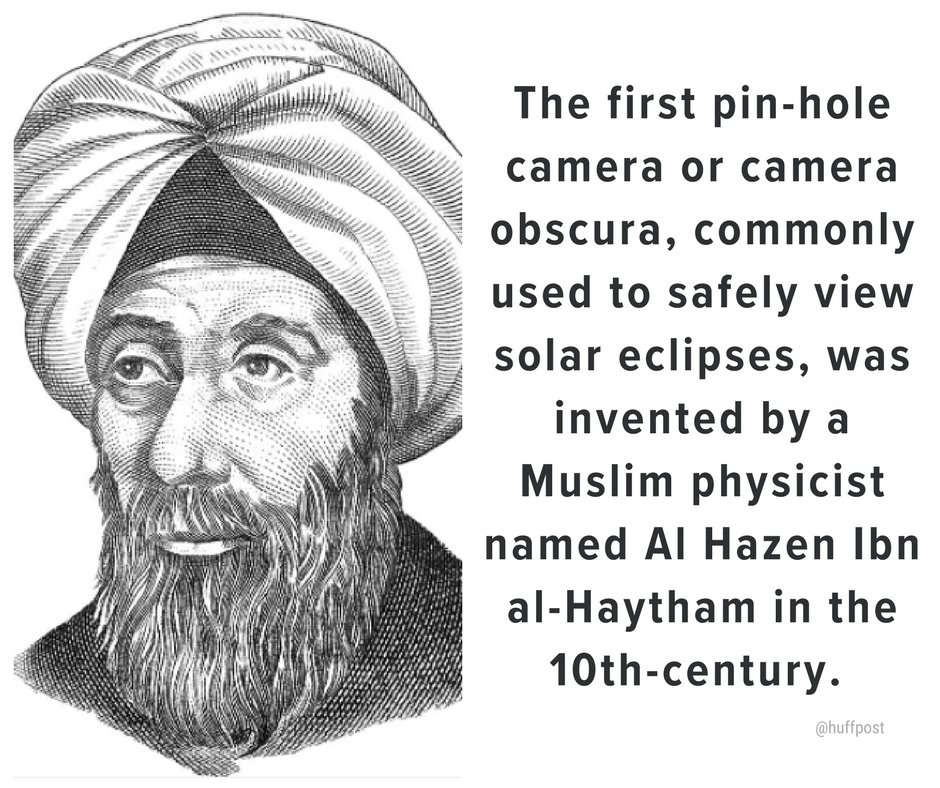
Thank you to NPR and Huffington Post for this information:


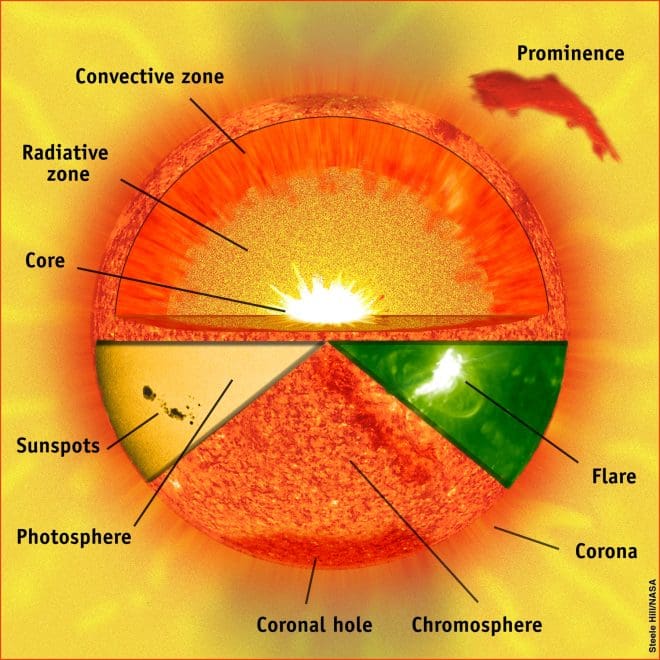
And here's more about the structure of the sun:


from The Sun Today:

http://www.thesuntoday.org/the-sun/solar-structure/

Moon Shadow Is Common

Moon to right above sun at 12 noon, Aug. 21 in Santa Monica (with filter)

Solar eclipses happen about every 18 months, so I couldn't get fired up over this one.

Everybody knows that the moon rotates around Earth.  That means that it passes between Earth and the Sun every month.

Because the moon is so small and 238,900 miles from Earth and doesn't rotate  in the same plane with Earth and Sun, its shadow doesn't always touch Earth, but one out of 18-20 times, the shadow does touch our planet.

Thank you to Sarah Chodosh for explaining this in the journal Popular Science:

http://www.popsci.com/total-eclipses-frequency

Because our planet is so big and much of it is covered by water, any one spot on a continent doesn't move under the moon's shadow that often.

But it's not that big a deal.  

I'm much more interested in the movement of Earth's tectonic plates over millions of years than in the shadow of the moon passing over us today.  


And here's a list of notable eclipses in the 20th Century:

https://en.wikipedia.org/wiki/List_of_solar_eclipses_visible_from_the_United_States

In any case, it's good to look outside the smaller concerns of life on Earth and look instead at movements of the sun, moon, and stars--and the changes in our own planet over millions and billions of years.


Wednesday, August 2, 2017

Crossing Ice Packs on the Trail


I was trying to get to a beautiful high Alpine valley near Sonora Pass on July 14, but I encountered a gully that contained the remnant ice of many snow slides last winter.

I wasn't brave enough to cross it--I hadn't brought hiking poles and didn't have a companion to call for help in case I slid down the snow.  

I hiked up the side of the hill next to it and found a beautiful meadow of tiny Alpine flowers as well as spectacular views--but I didn't go back down to the trail on the other side of the slide. That would have required me to walk back up on the way back.

But today I feel justified in my decision.  The LA Times reports that all high-altitude hikers in California are having a tough time this summer, especially those doing the 3,000-mile Sierra Highline Trail.

http://www.latimes.com/local/lanow/la-me-ln-pacific-crest-trail-dangerous-20170802-story.html

The photo of the hiker with poles inching across the snow tells it all.

See also this report on Mono Lake doing well this year, sent by my friend Diane, who researched and gave me instructions to the hike near Sonora Pass.

http://www.monolake.org/today/2017/07/20/mono-lake-rose-a-record-amount-in-june-2017/

Monday, July 10, 2017

Creatures Great and Small


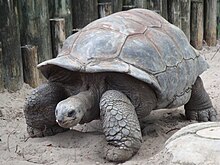
What an amazing story on NPR today about tortoises in the Galapagos Islands!

http://www.radiolab.org/story/galapagos/

There's beauty in the amazing biodiversity and adaptation of creatures to changes in their environment... from finches to tortoises.

In the show there's also humor and sadness--how a few goats brought by pirates grew into hundreds of thousands that ate the food supply of other animals in the islands.

Much food for thought... hallelujah!

Thank you to Radio Lab for this hour-long show.

Friday, July 7, 2017

Snowmelt & Danger on the Pacific Crest, 2017


Amazing snowpack has created record snow melt and flooding in the Sierra Nevada...  I took this photo on July 8, 2017, with these trees at about 10,000 ft. still surrounded by snow.  The scene is about two miles from the Pacific Crest Trail.

For more photos, see:

http://www.latimes.com/local/california/la-me-flooding-sierra-nevada-20170714-htmlstory.html


People hiking the Pacific Crest Trail were endangered by higher-than-normal streams to cross.  Two drowned, one slipped to his death on ice, and one probably died from heat or dehydration.

https://www.pcta.org/2017/sadness-deaths-pacific-crest-trail-50680/