Wednesday, July 13, 2016

When the Spirit Leaves


Hypothesis

Perhaps when the spirit leaves its body
it flies to the star that is its destiny
a few billion light-years away
and buries itself in the flame
where its tarnished edges
are all burnt away
leaving only its truest essence.

I wish this for you, Rizz—
residence in a star of regal beauty
trailing streams of iodized clouds,
purple and green—
your own bright spirit freed from earth
and perpetually glowing
in the light of God’s face.

And if your spirit does not leave tonight,
may you not suffer.
may you not return to conscious thought
but rest in peace
until your spirit is freed.
                                                --Anne Eggebroten, July 13, 2016

                            “In my house are many mansions” John 14:2

Thursday, June 30, 2016

Double Take


Carlos took this photo while walking on the Seine River in Paris in June 2016.


Compare the painting hanging over our fireplace:


Good eye, Carlos!  You took the same scene painted so many years earlier--and there has been very little change!

Saturday, January 30, 2016

Holy Mountain

Vermillion Peak, November 2015


Some mountains look like God... or at least the throne of God.


Thursday, January 28, 2016

Clouds


Blue sky is beautiful, 
but even more beautiful
with cumulus clouds 
blown into a symmetrical pattern...

Hallelujah!

Monday, January 4, 2016

Chant of the Incarnation


Here's a hymn about the theophany, the mystery of the Creator of all appearing in human form. 

It's the Christmas Troparion sung in Arabic and written by St. Romanos the Melodist.

https://www.youtube.com/watch?v=MvjiVam2HO4

Romanos was born into a Jewish family in Syria, either modern Homs (then Emesa) or Damascus, according to Wikipedia.  He was baptized as a young boy, whether through his parents' conversion or his own.

He moved to Constantinople "during the reign of Athanasius"--whether Anastasius I (491-518) or Anastasius II(713-716) is not clear.

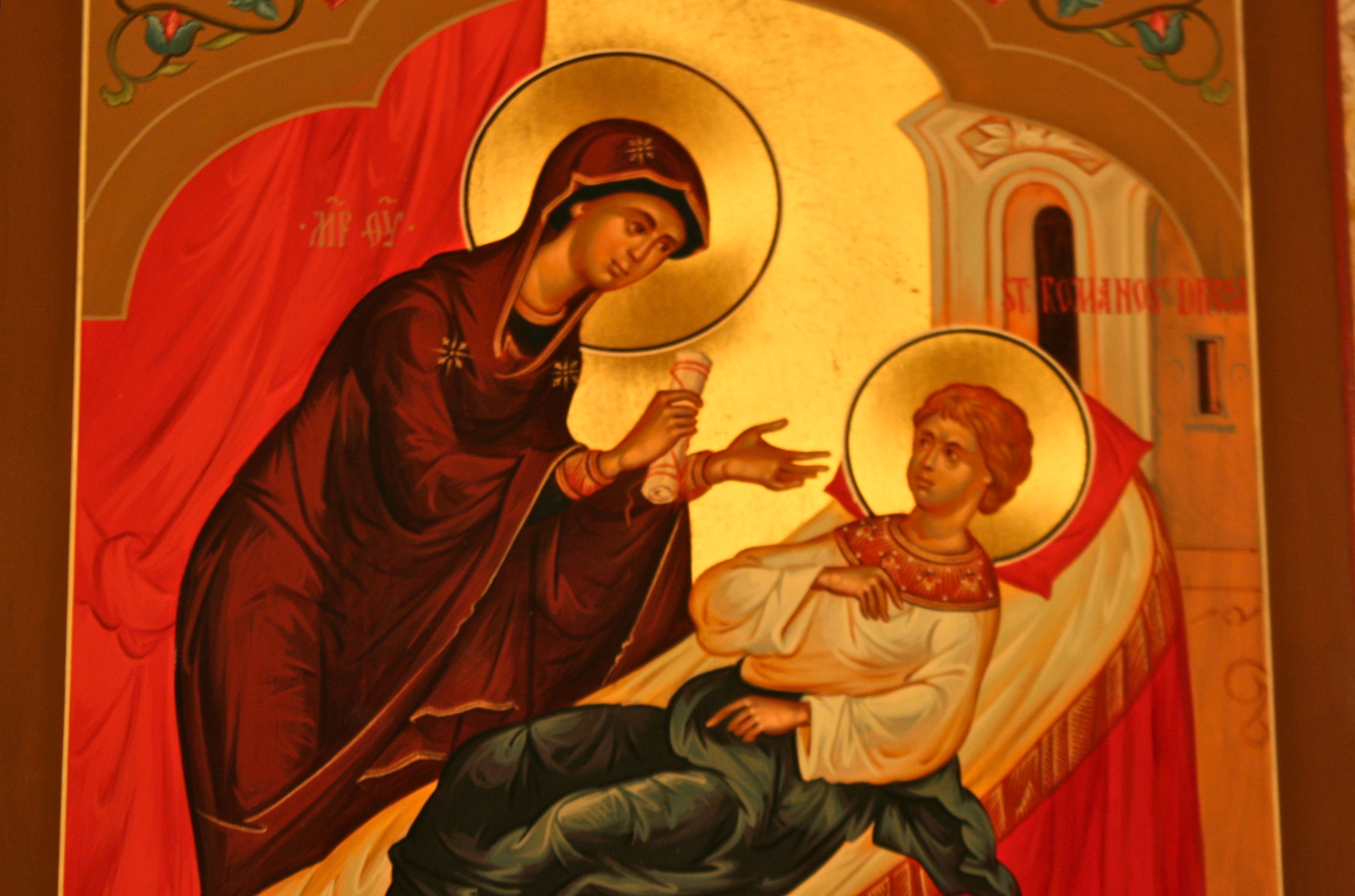
According to legend, he was a young deacon who on his turn to read the Psalms in worship, read so poorly that he was ridiculed.  Then the Virgin Mary appeared to him and gave him a scroll to eat.  He woke up and chanted his famous Kontakion of the Nativity (sung on the link above).  

He is said to have composed in Greek over a thousand kontakia.  Each one is a poetic sermon of 18-30 verses, each with a refrain and united by an acrostic pattern.

Anyway, listen to this ancient hymn, a taste of how the incarnation was approached long before the days of Santa Claus and reindeer.

Sunday, January 3, 2016

One More Seed...

Mountain goat in Zion National Park

Animals and people seeking food and spiritual sustenance in dark days of winter...

Today, the tenth day of Christmas, I went to Jeannette Scholer's home in Pasadena to sing carols.

We sang "People Look East" by Eleanor Farjeon (who wrote "Morning Has Broken") and other lesser-sung carols.

My favorite verse:

Furrows, be glad.  Though earth is bare,
One more seed is planted there:
Give up your strength the seed to nourish,
That in course the flower may flourish.
People, look east and sing today:
Love, the rose, is on the way.

I first heard this carol during Advent when I was pregnant with my first child, born March 20, 1982. 

"Give up your strength" was an insight I could relate to--Mary's suffering to bear Jesus.

Now, 34 years later, I have more understanding of what strength and nourishing three children would require over the years.

That first child was named "Rosamond" for her paternal grandmother.  A rose was indeed on the way.


See also:

http://www.hymnsandcarolsofchristmas.com/


Monday, December 28, 2015

Mysteries of Dinaledi Cave


Homo sapiens, humans with brains like ours, have been around for about 200,000 years.

Various members of the genus Homo have been around for 2 to 3 million years.

Another genus in the ape family, the Australopithecines, has been around for 4 million years.  Its most famous archaeological remain is Lucy, a member of Australopithecus afarensis, found in 1974 in Ethiopia.

The cover article in the October 2015 issue of National Geographic Magazine discusses new findings in a cave thirty miles northwest of Johannesburg, South Africa, the Rising Star Cave.


In this cave are remains of at least 15 individuals from infant to elderly and both genders.  They seem to have been dropped in the furthest part of the cave as a kind of burial or protection.  

Fascinating, when you consider that these remains have brains less than half the size of ours.  They are 560 cu cm for the males, 465 for the females--nowhere near Homo erectus at 900 cu cm.  Our brains are nearly 1500 cu cm.


"The message we're getting is of an animal right on the cusp of the transition from Australopithecus to Homo," reports Lee Berger, the paleontologist at Witwatersrand University who has been studying them.

This article is the most interesting I have read in years.

I want to know more about these ape-like humans, possibly a missing link in our human development.

Were they indeed protecting the bodies of their dead relatives?

What were they thinking?

What were their family relationships like?  What did they eat?  Where did they live?

"It's an animal that appears to have had the cognitive ability to recognize its separation from nature," says Berger.

In other words, unlike my dogs, it may have understood that death would come.  It may have thought about its place in the world--"Why am I here?"

It may have had goals other than food and shelter and reproduction.

Did it think, "Who created all this?  Is there another Being, larger than we are?"

I am fascinated by this evidence of early human-like behaviors in a being not yet Homo sapiens.

I want to know God's thoughts about these creatures.  For 2-3 million years, they were the most interesting creatures on Earth, perhaps God's pride and joy.

These questions bring to mind Bethany Sollereder's article "The Purpose of Dinosaurs: Extinction and the Goodness of God" in Christian Century, Oct. 2, 2013 (vol. 130, no. 20).

"Thug God's providential action is twofold," she concludes.  "Each individual creature and species is an end in itself, existing for the glory and delight of God in that moment; and the disparate story lines of all beings that exist or have existed are wound unto the epic tale of earth's history."